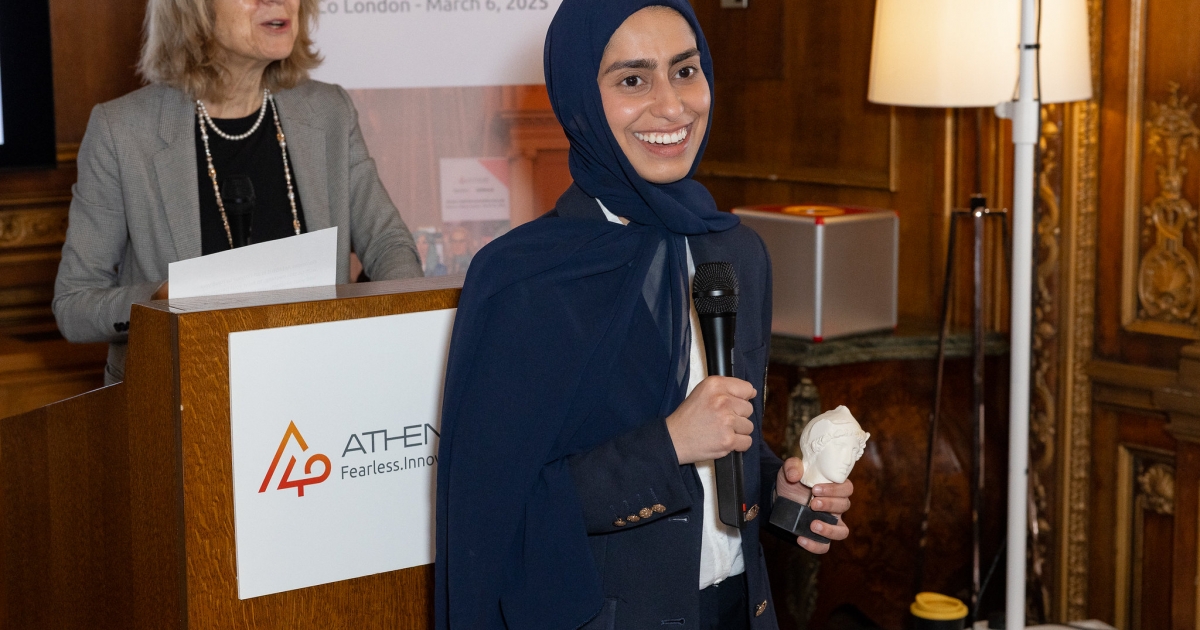
“Understanding People Is just as Important as Understanding Systems”
Young Emirati inventor Fatima Alkaabi has gained international recognition for creating technologies that address real-world challenges and inspire the next generation of innovators. In this interview with Global Thinkers Forum, she reflects on her journey, the ideas behind her inventions, and the importance of encouraging young people - especially girls - to pursue STEM and innovation.
Q: You began inventing at a remarkably young age. What first sparked your curiosity for innovation, and how did your childhood experiences shape your path as an inventor?
A: I started inventing when I was around ten years old. What sparked it was simple curiosity. I was always the kind of child who wanted to understand how things worked. I would open devices, experiment with tools, and try to improve things around me. I had a small yellow toolbox that I carried everywhere, and to me it felt like possibility.
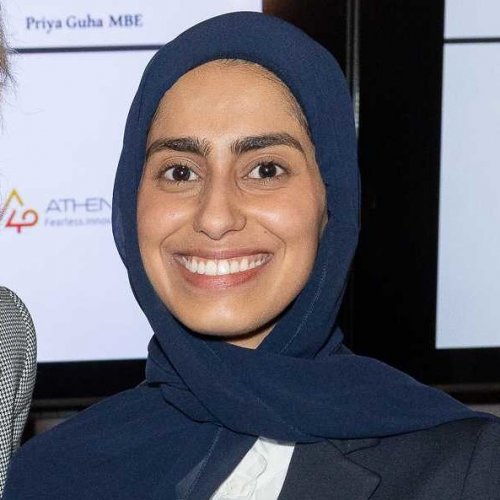
Fatima Alkaabi
IP Engineer, Yahsat Space Services
Fatima Alkaabi is Virginia Tech graduate who studied Computer Engineering with secondary focuses in Women and Gender Studies and Science, Technology and Society.
Recognized as the Youngest Emirati Inventor in 2015, Fatima has had a passion for creativity and innovation since she was 7 years old. By the age of 17, she was able to create twelve inventions that focus on solving issues found around her community such as a smart steering system to prevent texting while driving and the Teleporter, a robot that attends school for sick children.
Fatima’s work revolves around creating social platforms around innovation and creativity. Through volunteer tutoring and workshops, she has shared her passion for and knowledge of the sciences to more than 3000 students across her region. In 2016, Fatima obtained an internationally accredited certification for peer-to-peer training and counseling.
But it was not just about taking things apart. It was about solving problems. If I saw something inefficient or unfair, I could not ignore it. I would think about how to fix it. That mindset shaped me early on.
Growing up in the UAE also influenced me deeply. I was surrounded by a culture that valued ambition and progress. Seeing how quickly the country developed made innovation feel normal, not intimidating. It made me believe that ideas, even from young people, could matter.
Those childhood experiences taughtme two things. Stay curious, and build solutions instead of complaints.
Q: As a young person entering fields often dominated by older professionals, what were the biggest challenges you faced in being taken seriously, and how did you overcome them?
A: The biggest challenge was perception. When you are young, especially in technical fields, people sometimes assume your work is a school project rather than serious innovation. There were moments when I walked into rooms and people were surprised that I was the inventor.
At first, that can feel discouraging. But I realized I had to focus on preparation. I made sure I understood my projects deeply, not just how they worked, but why they mattered, how they could be implemented, and what problem they solved.
When you know your work thoroughly, you speak differently. Confidence becomes natural. Over time, consistency builds credibility. I kept showing up. I kept building. Eventually, the work speaks for itself.
Q: Was there a moment when you questioned yourself or your path? How did you manage self-doubt or external skepticism?
A: Yes, there were moments. Especially when facing structural barriers, like challenges patenting inventions at a young age, or when projects took longer than expected. There were times when I wondered if I was pushing too hard or aiming too high.
Self-doubt is part of growth. Whenever I felt it, I tried to separate emotion from reality. I would ask myself, do I still believe in the purpose behind this idea? If the answer was yes, then I knew the doubt was temporary.

Q: Innovation requires more than technical skill. How has emotional intelligence helped you collaborate, lead, and persevere? Technical skill allows you to build something. Emotional intelligence allows you to build it with others.
A: As I grew into leadership roles and began collaborating across different sectors, I realized that understanding people is just as important as understanding systems. You need to read the room. You need to know when to push forward and when to listen.
Emotional intelligence helped me manage pressure. It helped me handle criticism without taking it personally. It helped me communicate complex ideas in ways that different audiences could understand.
Innovation is rarely a solo journey. It requires teams, stakeholders, and community. The ability to understand motivations, fears, and expectations makes collaboration stronger.
A: When you are recognized young, expectations come very quickly. People start projecting their hopes onto you. Your family wants you to succeed. Society feels proud. The media often frames you as a symbol of something bigger.
At the beginning, that pressure can feel heavy. You feel like you always have to be achieving something, always progressing, always representing excellence.
What helped me was understanding that I cannot live according to expectations. I have to live according to intention. I constantly check in with myself and ask why I am doing something. If it aligns with my values and purpose, I continue. If it feels like I am performing for approval, I step back.
Q: Growing up in the UAE, how has your cultural background shaped your leadership style and approach to innovation? How important is cultural intelligence in global scientific collaboration?
A: Growing up in the UAE shaped how I see possibility. I grew up watching a country transform rapidly within one generation. That creates a mindset where big ideas do not feel unrealistic. They feel achievable with vision and commitment.
Emirati culture emphasizes humility, respect, and collective success. Leadership is often service oriented. That influenced me deeply. I lead by listening. I think about impact on community. Innovation for me is not about building something impressive for attention. It is about building something meaningful that contributes.
Cultural intelligence is extremely important in global scientific collaboration. Technology does not operate in isolation. It enters societies with different values, traditions, and sensitivities. If you ignore cultural context, even strong innovation can fail in practice.
Q: What role did your family play in your journey? Were they immediately supportive of your ambitions, or did it take time to build that understanding?A: My family has been my foundation from the beginning. When I started inventing at ten years old, it did not look like a clear career path. It looked like a curious child experimenting.
But instead of discouraging me, they gave me space to explore. That space was powerful.
Support does not always mean full understanding from day one. Sometimes it simply means believing in the person before the results are visible. As my projects became more serious and more public, there were natural concerns. That is normal. But over time, as they saw my dedication and progress, that understanding strengthened.
Q: What essential qualities do you believe women need to cultivate to thrive and lead in science, technology, and innovation sectors?
A: The first is competence. Know your field deeply. When you understand your work technically, you carry yourself differently in professional spaces.
The second is resilience. There will be moments of doubt, both internal and external. You cannot let those moments define your self-worth.
The third is emotional intelligence. Innovation is not only about ideas. It is about collaboration. You need to communicate clearly, understand different personalities, and navigate complex environments.
Q: Have you ever faced gender-related obstacles in your career? If so, how did you navigate them, and what advice would you give to young women entering male-dominated industries? Any setbacks that you had to handle and thrive again?
A: Yes, there have been moments where I could sense that being young and female influenced how people initially perceived me. Sometimes it was subtle. Sometimes it was more visible, like being one of very few women in technical rooms.
I decided early on not to internalize that. Instead, I focused on mastering my craft. When you truly understand your work, assumptions start to fade.
I have also faced setbacks beyond gender. There were structural challenges when I tried to patent inventions at a young age. There were projects that took years longer than expected.
My advice to young women entering male dominated industries is simple. Do not shrink yourself to make others comfortable. Do not wait for permission to speak or lead.
Published: 26/02/2026